LOKPAL BILL
 The
word Lokpal means an ombudsman in India. The word has been derived from the
Sanskrit words "loka" (people) and "pala" (protector/caretaker). So the word
Lokpal means 'protector of people'. The concept of Lokpal has been drawn up to
root out corruption at all levels in the prevailing Indian polity.
The
word Lokpal means an ombudsman in India. The word has been derived from the
Sanskrit words "loka" (people) and "pala" (protector/caretaker). So the word
Lokpal means 'protector of people'. The concept of Lokpal has been drawn up to
root out corruption at all levels in the prevailing Indian polity.
The Lokpal will be a three-member body with a chairperson who
is or was a chief justice or Supreme Court judge, and two members who are or
have been high courts judges or chief justices.Implementation of the Lokpal bill
will hopefully reduce corruption in India. The basic idea of the Lok Pal is
borrowed from the office of ombudsman, which has played an effective role in
checking corruption and wrong-doing in Scandinavian and other nations. In early
1960s, mounting corruption in public administration set the winds blowing in
favour of an Ombudsman in India too.
The Administrative Reforms Commission (ARC) set up in 1966
recommended the constitution of a two-tier machinery - of a Lokpal at the
Centre, and Lokayukta(s) in the states.the Lokpal has to complete the inquiry
within six months.
Duties of Lokpal are as follows:
1. To judge the cases and make jurisdictions against corruption cases with
the Lokpal.
2. To judge whether a case is legal or whether a fake complaint has been made.
3. To potentially impose fines on a fake complaint, or even a short span of jail time, if the case is not proved to be legally true.
2. To judge whether a case is legal or whether a fake complaint has been made.
3. To potentially impose fines on a fake complaint, or even a short span of jail time, if the case is not proved to be legally true.
In India, the Jan Lokpal Bill (also referred to as the
citizens' ombudsman bill) is a proposed anti-corruption law designed to
effectively deter corruption, redress grievances and protect whistleblowers. The
law would create an ombudsman called the Lokpal; this would be an independent
body similar to the Election Commission of India with the power to prosecute
politicians and bureaucrats without prior government permission.
A compromise bill, merging the Government's version and that
of the civil group's version (Jan Lokpal), is being drafted by a committee of
five Cabinet Ministers and five social activists. As of July 2011, the most
current version of the bill is version 2.3, according to the government website.
For 42 years, the government-drafted bill has failed to pass the Rajya Sabha,
the upper house of the Parliament of India.The first Lokpal Bill was passed in
the 4th Lok Sabha, the lower house of the Parliament, in 1969 but stalled in the
Rajya Sabha. Subsequent Lokpal bills were introduced in 1971, 1977, 1985, 1989,
1996, 1998, 2001, 2005 and 2008 but all failed to pass.
Latest Developments
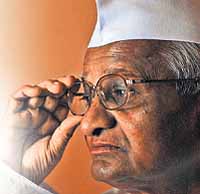
Anna Hazare, a Gandhian rights activist, had started a fast
unto death at Jantar Mantar in New Delhi demanding the passing of the bill.
Hazare called off his hunger strike on the 9th of April, 2011 bringing to an end
his 98-hour protest after the government issued a gazette notification
constituting a 10-member Joint Committee of government ministers and civil
society activists, including him, to draft a bill for the creation of an
effective Lokpal.
Drafting Committee
The drafting committee was officially formed on 8 April 2011.
It consists of ten members, including five from the government and five drawn
from society.
Chairmen
The Government of India accepted that the committee be
co-chaired by a politician and an activist, non-politician. It is reported that
Pranab Mukherjee, from the political arena, and Shanti Bhushan, from civil
society, will fill those roles.
Government representation (Five Cabinet ministers )They
are:
» Pranab Mukherjee, Finance Minister, Co-Chairman;
» P. Chidambaram, Minister of Home Affairs;
» Veerappa Moily, Minister of Law and Justice;
» Kapil Sibal, Minister for Communications and Information Technology; and
» Salman Khursid, Minister of Water Resources.
» Pranab Mukherjee, Finance Minister, Co-Chairman;
» P. Chidambaram, Minister of Home Affairs;
» Veerappa Moily, Minister of Law and Justice;
» Kapil Sibal, Minister for Communications and Information Technology; and
» Salman Khursid, Minister of Water Resources.
Civil society representation (Five leading social
activists). They are:
» Shanti Bhushan, Former Minister of Law and Justice, Co-Chairman;
» Anna Hazare, Social Activist;
» Prashant Bhushan, Lawyer;
» N. Santosh Hegde, Lokayukta (Karnataka); and
» Arvind Kejriwal.
» Shanti Bhushan, Former Minister of Law and Justice, Co-Chairman;
» Anna Hazare, Social Activist;
» Prashant Bhushan, Lawyer;
» N. Santosh Hegde, Lokayukta (Karnataka); and
» Arvind Kejriwal.
Thousands of people from all over India, especially the
youth, supported Anna Hazare's cause by candle light marches and online
campaigns through social media.Recently Yoga guru, Swami Ramdev, was on a fast
for this cause for 9 consecutive days from 4 June - 12 June 2011. He wanted the
Government of India to accept various demands which mainly included those
related to the Lokpall bill.Anna Hazare on the 8th of June, 2011, declared that
he will restart his fast unto death on the 16th of August if the Lokpal bill is
not passed by the Parliament of India by 15 August, which is the Inependence Day
of India.On the 16th of June, the civil society reported that only 15 points of
total 71 that they recommended have been agreed to by the Joint Committee
consisting of five central ministers. Following differences with the Civil
Society, the team of five central ministers decided to forward two drafts of the
Lokpal Bill to the Cabinet, one from each side.
The Jan Lokpal Bill (Citizen's ombudsman Bill) is a draft
anti-corruption bill drawn up by prominent civil society activists seeking the
appointment of a Jan Lokpal, an independent body that would investigate
corruption cases, complete the investigation within a year and envisages trial
in the case getting over in the next one year. Drafted by Justice Santosh Hegde
(former Supreme Court Judge and present Lokayukta of Karnataka), Prashant
Bhushan (Supreme Court Lawyer) and Arvind Kejriwal (RTI activist), the draft
Bill envisages a system where a corrupt person found guilty would go to jail
within two years of the complaint being made and his ill-gotten wealth being
confiscated. It also seeks power to the Jan Lokpal to prosecute politicians and
bureaucrats without government permission.
Salient features of Jan Lokpal Bill:
1. An institution called LOKPAL at the centre and LOKAYUKTA in each state
will be set up.
2. Like Supreme Court and Election Commission, they will be completely independent of the governments. No minister or bureaucrat will be able to influence their investigations.
3. Cases against corrupt people will not linger on for years anymore: Investigations in any case will have to be completed in one year. Trial should be completed in next one year so that the corrupt politician, officer or judge is sent to jail within two years.
4. The loss that a corrupt person caused to the government will be recovered at the time of conviction.
5. How will it help a common citizen: If any work of any citizen is not done in prescribed time in any government office, Lokpal will impose financial penalty on guilty officers, which will be given as compensation to the complainant.
6. So, you could approach Lokpal if your ration card or passport or voter card is not being made or if police is not registering your case or any other work is not being done in prescribed time.
2. Like Supreme Court and Election Commission, they will be completely independent of the governments. No minister or bureaucrat will be able to influence their investigations.
3. Cases against corrupt people will not linger on for years anymore: Investigations in any case will have to be completed in one year. Trial should be completed in next one year so that the corrupt politician, officer or judge is sent to jail within two years.
4. The loss that a corrupt person caused to the government will be recovered at the time of conviction.
5. How will it help a common citizen: If any work of any citizen is not done in prescribed time in any government office, Lokpal will impose financial penalty on guilty officers, which will be given as compensation to the complainant.
6. So, you could approach Lokpal if your ration card or passport or voter card is not being made or if police is not registering your case or any other work is not being done in prescribed time.
Lokpal will have to get it done in a month's time. You could
also report any case of corruption to Lokpal like ration being siphoned off,
poor quality roads been constructed or panchayat funds being siphoned off.
Lokpal will have to complete its investigations in a year, trial will be over in
next one year and the guilty will go to jail within two years.
7. But won't the government appoint corrupt and weak people
as Lokpal members? That won't be possible because its members will be selected
by judges, citizens and constitutional authorities and not by politicians,
through a completely transparent and participatory process.
8. What if some officer in Lokpal becomes corrupt? The entire
functioning of Lokpal/ Lokayukta will be completely transparent. Any complaint
against any officer of Lokpal shall be investigated and the officer dismissed
within two months.
9. What will happen to existing anti-corruption agencies? CVC,
departmental vigilance and anti- corruption branch of CBI will be merged into
Lokpal. Lokpal will have complete powers and machinery to independently
investigate and prosecute any officer, judge or politician.
10. It will be the duty of the Lokpal to provide protection
to those who are being victimized for raising their voice against corruption.
Some people have opined that the Jan Lokpal Bill is 'Naïve'
in its approach to combating corruption. The Lokpal concept was criticized by
the Human Resource Development (HRD) minister Kapil Sibal because of concerns
that it will lack accountability, oppresively, and undemocratically.The claim
that the Lokpal will be an extra-constitutional body has been derided by
Hazare’s closest lieutenant, Arvind Kejriwal. He states the Jan Lokpal Bill
drafted by civil society will only investigate corruption offences and submit a
charge sheet which would then tried and prosecuted, through trial courts and
higher courts. Kejriwal further states that the proposed bill also lists clear
provisions in which the Supreme Court can abolish the Lokpal.Although Kejriwal
has stated that all prosecutions will be carried out through trial courts, the
exact judicial powers of LokPal is rather
unclear in comparison with its investigative powers.
unclear in comparison with its investigative powers.
The bill requires "...members of Lokpal and the officers in
investigation wing of Lokpal shall be deemed to be police officers". Although
some supporters have denied any judicial powers of Lokpal,the government and
some critics have recognized Lokpal to have quasi-judicial powers.The bill
states that "Lokpal shall have, and exercise the same jurisdiction powers and
authority in respect of contempt of itself as a High court has and may exercise,
and, for this purpose, the provisions of the Contempt of ourts Act, 1971
(Central Act 70 of 1971) shall have the effect subject to the modification that
the ref rences therein to the High Court shall be construed as including a
reference to the Lokpal." Review of proceedings and decisions by Lokpal is
prevented in the bill, stating "...no proceedings or decision of the Lokpal
shall be liable to be challenged, reviewed, quashed or called in question in any
court of ordinary Civil Jurisdiction." Without judicial review, there is concern
that Lokpal could become a extra-constitutional body with investigative and
judicial powers whose decisions cannot be reviewed in regular courts.
Whether or not to include the Prime Minister and higher
judiciary under the Lokpal remains as one of the major issues of dispute.
Although Hazare proposed Justice Verma, the former Chief Justice of the Supreme
Court, as the Chairman of the Lokpal Bill panel,Justice Verma later expressed
his constitutional objections for including the Prime Minister and higher
judiciary under Lokpal, stating "this would foul with the basic structure of the
constitution".
Difference Between Draft Lokpal Bill 2010 and Jan Lokpal Bill
| Draft Lokpal Bill (2010) | Jan Lokpal Bill
(Citizen's Ombudsman Bill) |
| » Lokpal will have no power to initiate suo motu
action or receive complaints of corruption from the general public.
It can only probe.» Complaints forwarded by the Speaker of the
Lok Sabha or the Chairman of the Rajya Sabha. » Lokpal will only be an Advisory Body with a role limited to forwarding reports to a "Competent Authority". » Lokpal will have no police powers and no ability to register an First Information Report or proceed with criminal investigations. » The CBI and Lokpal will be unconnected. » Punishment for corruption will be a minimum of 6 months and a maximum of up to 7 years. |
» Lokpal will have powers to initiate suo moto
action or receive complaints of corruption from the general public.
» Lokpal will have the power to initiate prosecution of anyone
found guilty. » Lokpal will have police powers as well as the ability to register FIRs. » Lokpal and the anti corruption wing of the CBI will be one independent body. » Punishments will be a minimum of 5 years and a maximum of up to life imprisonment. |
India is a country where honesty and integrity in public and
private life have been glorified andupheld in great epics such as the Vedas,
Upanishads and in the books and practices of everyreligion practiced here.Yet,
India today is one of the most corrupt countries in the world.Bringing public
servants under a scanner which makes them strictly accountable is the start of
amovement against corruption in India. And one significant step in attacking the
spectre ofcorruption in India will be the implementation of the lok pal bill.
In the regular dispensation of government there are implicit
and explicit ways that citizens canvoice their grievances and demand change. But
these are often difficult. Within administrative departments, for example, any
decision of one official can be appealed to a higher official, all the way up to
the head of a department. However, this mechanism has inherent flaws.But it can
be said that Lokpal is the need of the hour and it will have to be implemented
first ,then only we can decide whether it is fruitful or not.
With the revelations coming out of so many SCAMS for the past many months, it is all the more necessary to bring even the P.M , Judiciary and the actions of MPs on the floor of the house under the perview of LOK PAL bill without any exception. It is hoped that better counsel will prevail on our
ReplyDeleteleaders at the time of discussion and pass the bill as proposed by the Citizens forum. Then only ours can be called a Democratic Country.